The Social Media Channel |
- Which social networks are people using to get breaking news?
- The best social media service for businesses? Instagram, according to SumAll year-end report
- How to delete and protect the digital identities of the deceased
- Why Twitter should focus on even more local features
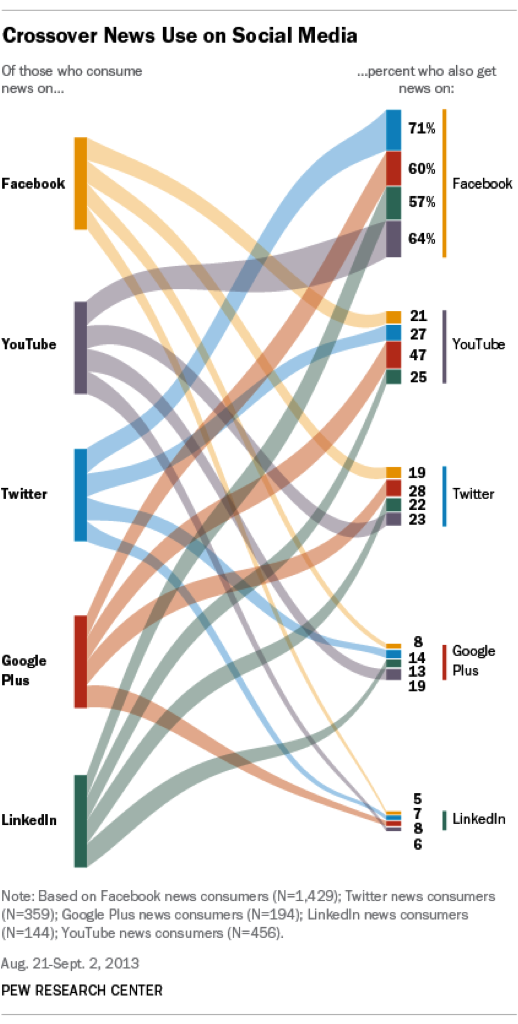
| Which social networks are people using to get breaking news? Posted: 06 Dec 2013 07:20 AM PST  Anna Francis is the Content and Social Media Specialist at Blueclaw. How do you usually find breaking news, or consume news in general? For the most part, it's unlikely that you'll wait all day to learn from nightly broadcasts or the physical paper the next morning. In July 2012, the first Reuters Institute Digital Report found that 43 percent of Brits between the ages of 16 and 24 were most likely to discover news stories through social networks instead of using search engines. It was deemed that Facebook was the most important social network for news discovery, with over 55 percent of all news sharing taking place on the platform – compared to only 33 percent over email and 23 percent over Twitter. A recent study from Pew Research, however, found that approximately half of Facebook and Twitter users find out about news on the respective platforms, but the real news source within social media is Reddit. The study showed that 62 percent of Reddit users found out about news from the site: 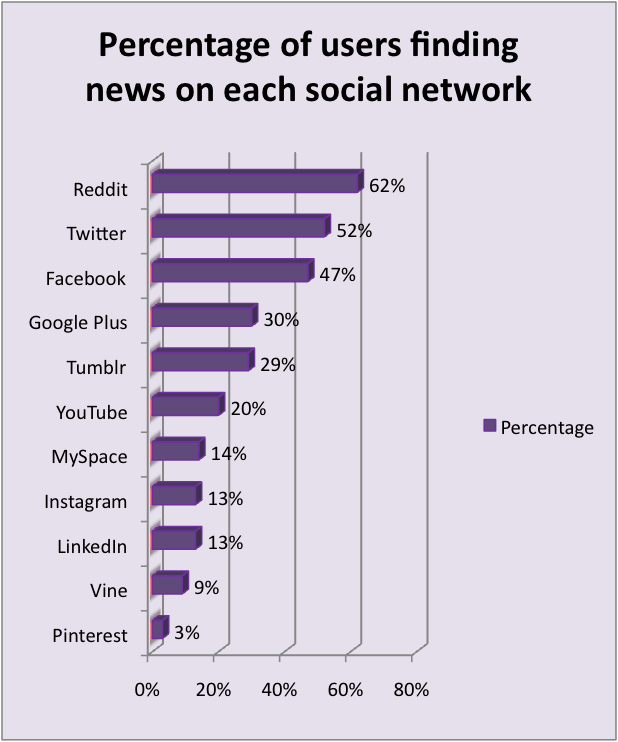 Data collected between August 21st and September 2nd 2013 from Pew Research These are very significant findings, as social media sites have become a key part in both sharing and discovering news. News organisations around the world are now turning to the Internet and in particular social media platforms to reach their audience, as older forms of media (such as print) are beginning to have less impact as a "breaking news" source. This obviously works out well for social media platforms. With more eyes looking their way, the viewership gives them a great base for advertising – the key here is for news organisations and social media networks to work in a smooth partnership and ensure that they do not get in each other's way at any point. The results of the survey are interesting, as Reddit is quite a niche site and with 69.8 million monthly users, it's done incredibly well to compete against Facebook's user base of 1.19 billion. Do social media platforms' news audiences overlap?Do users find their news across multiple platforms, or are they loyal to just one network? The research from Pew has found that actually 65 percent of the news audiences get their news from only one site, with 26 percent finding it on two sites. The interesting thing about this, is that for those who found their news on multiple sites, Reddit does not seem to feature as one of them: This demonstrates that the news audience on Reddit are loyal to the site and unlikely to switch between social networks at any point. But why is Reddit favoured as a news source? One of the main reasons it has such a high percentage of loyal fans, is because its main feature is being a real-time news aggregator where the most relevant news is dictated by the user base, not the media. With users submitting their own stories and news articles, the social network provides up-to-date news alerts and categorises them based on social voting. After the Colorado shooting during a screening of "The Dark Knight Rises" in 2012, Reddit provided support and live updates with a board showing the statuses of victims; transforming the social network into a story board. Furthermore, Reddit's threaded comments system is a simple way of curating the best comments (regardless of when posted) very quickly. Facebook on the decline?The main problem with Facebook when it comes to providing up-to-date news, is that it is often overwhelmed by pages of pictures and videos and streams of statuses and "mind boggling" quotes. Added to this are an array of sponsored stories and advertising, meaning finding the latest headline can be like finding a needle in a hay stack. Facebook has tried to help make it easier to find content with the launch of hashtags – but ultimately, the newsfeed is where most users look to. But is Facebook becoming old news? Not just yet. It still ranked third as a news source, showing Internet users still rely on it to provide up to date headlines and stories. As it proved to be the most popular network for those who take their news from more than one site, it still plays an integral part in delivering up to date news stories to audiences around the world. With all this in mind, what does the future hold for Facebook? It has recently been reported that teenagers are ditching the social platform in favour of messaging apps such as WhatsApp and WeChat, as they offer a more private way for users to chat and share pictures without having to scroll through updates from the hundreds of acquaintances on Facebook. It is easy to think that Facebook will continue to grow for years to come with more features drawing users back in, but MySpace showed us years ago that a fall from grace can happen at any point. Facebook is most definitely not immune to that situation. Image credit: Oleksiy Mark/Shutterstock  This posting includes an audio/video/photo media file: Download Now |
| The best social media service for businesses? Instagram, according to SumAll year-end report Posted: 05 Dec 2013 10:10 AM PST  Marketing analytics service SumAll has released a year-end report that characterizes Instagram as the most effective social network for companies looking for subscriber growth, engagement and a sales boost. Though Instagram recently opened up for advertising, SumAll's figures relate to unpaid and organic Instagram traffic. According to data from SumAll's clients for the first 11 months, US businesses that used Instagram saw revenue increases between 1.5 to 3.5 percent, while UK companies experienced an estimated 3.6 jump in revenue due to Instagram activity. SumAll said it only counted clients with data for the four main social media services: Instagram, Twitter, Google+ and Facebook. "All four of the networks continue to show their value, with Facebook still established as the overall leader in sales ROI," SumAll CEO Dane Atkinson said in a statement. But according to our results, if a company has a visual product to sell and it's currently not on Instagram, that company is missing out on significant brand awareness and revenue." For instance, bicycle maker Pure Fix Cycles estimates that each Instagram post brings in about $100 in additional revenue. Still, that's not a reason to post indiscriminately. SumAll also noted that businesses experienced diminishing returns on platforms that they targeted for heavy outreach. Atkinson instead suggested a "modest, broad-based approach to social media." When we asked how SumAll is able to correlate Instagram activity with business gains, CEO Dane Atkinson provided the following explanation:
These kinds of studies are hard to take at full face value without seeing more of the data, but, considering that Instagram's business model only just got off the ground, the firm should at least be heartened by SumAll's findings. Teens may be leaving Instagram for Snapchat, but at least companies have a reason to stick around. Photo credit: Josh Edelson/AFP/Getty Images  This posting includes an audio/video/photo media file: Download Now |
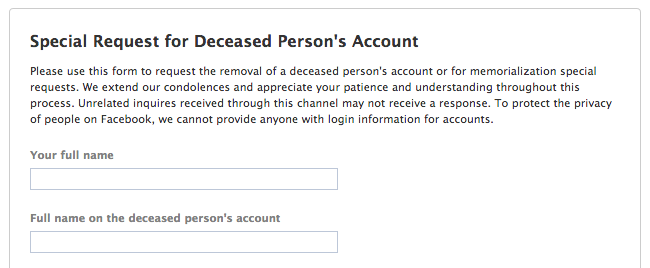
| How to delete and protect the digital identities of the deceased Posted: 05 Dec 2013 07:03 AM PST  Julie Myhre is the editor of NextAdvisor.com. As of May 2013, 72 percent of online adults use social networking sites, according to Pew Internet and American Life Project. The unfortunate aspect of so many people using social media is that when one of our friends or family members dies, we are forced to not only deal with their identity — in terms of their personal information — but also with their digital identity. Family members and friends question if they should take down the loved one's social media or leave it as a memorial for people to leave comments and reflect. Technically, there is no right decision to make in this difficult situation. However, family members and friends need to consider that if they leave the profile online, then they might be putting their loved one's identity at risk. This is mostly because of constantly changing privacy rules for all of the major social media websites. If the family members or friends do decide to delete the digital identity of their loved one, then here are some tips on how to request the removal of the deceased's account. This social network's policy is to memorialize the account of a deceased person, however it understands that some people want to delete the deceased person's account. To memorialize an account, you must contact Facebook, provide proof of death and request for the account to be memorialized. To delete an account on Facebook, you'll need to fill out this online form as well as provide proof that you're related to the deceased. Facebook considers appropriate proof to be a death certificate, the deceased person's birth certificate or proof of authority. Unlike Facebook, Twitter's policy is to deactivate the account of the deceased. In order to complete this you'll need to mail Twitter a packet of information, including the username of the deceased user's Twitter account, a copy of the deceased user's death certificate and a copy of your government-issued ID. On top of the copies of the official documents, Twitter also requires you to mail or fax the company a signed statement that includes your first and last name, your email address, your contact information, your relationship to the deceased person, written request to deactivate the account and a description of the details that show the account belongs to the deceased — if the account has a different name than the death certificate. You can also include a link to the online obituary, however adding this is not required. Once you've collected all of the information, mail or fax it to: Twitter, Inc. After you've mailed or faxed all of the required documentation, a representative of Twitter will contact you to complete the deactivation process. This social networking website requires you to send an email to support@instagram.com with the details of the person's account. A representative from the company will then email you back and include the steps and documentation that you need to remove the account. Similar to Facebook, LinkedIn prefers to have you fill out an online form, which asks for information such as the deceased member's name, deceased member's email address, the name of the company they recently worked for, your relationship to the deceased person and a link to the deceased person's email address. Once you complete the form, a LinkedIn representative should contact you. This site requires you to fill out an online contact form and explain that you'd like to deactivate the page of a deceased person. In the "body" of the contact form, you should include a link to the deceased person's Pinterest page or their Pinterest username. It's also important to note that once you're contacted by a Pinterest representative, you'll need to provide some sort of supporting documentation, such as an obituary or copy of the death certificate. TumblrSimilar to Instagram, Tumblr requires you to send an email to support@tumblr.com requesting to remove the account of the deceased person. Be sure to include a link to the deceased person's Tumblr or their Tumblr username. You'll then work with a Tumblr representative to prove the person is deceased — with appropriate documentation — and complete the process of removing the account. Since all of these companies have privacy policies that forbid them from giving out the account information — such as username and password — it's best if you, as a living person, write down the usernames and passwords for your social media accounts and keep them in a safe place. This way, your family and friends won't have to go through the stress of contacting each of the social networking websites to have your account removed because they'll instead be able to go into the account and deactivate or remove it themselves. Image credit: Orhan Cam/Shutterstock  This posting includes an audio/video/photo media file: Download Now |
| Why Twitter should focus on even more local features Posted: 04 Dec 2013 12:54 PM PST  Jonathan Barouch is the CEO and Founder of location-based analytics application Local Measure. I had an unusual experience this morning at my local cafe. While sipping my latte, I overheard an elderly couple at the next table discussing Twitter's market cap and what Twitter's future revenue opportunities are. Twenty-four months earlier, that very same couple may not have even known what Twitter was, let alone how they intend to make money. Herein lies Dick Costolo's (Twitter's current CEO, in case you were wondering) new reality. Twitter is public and Dick is the face of a very high profile global tech company. Every man and their dog will start to offer their opinions on Twitter's strategy. I, too, have a few ideas on where Twitter should focus some of its energies… and that place is local. While Twitter has experimented with location-based features in the past, we haven't seen many new features to support location in the last 12 months. On a recent trip to Singapore, I noticed my tweets from the Twitter app were being incorrectly geo-tagged to the neighbouring country of Malaysia. This highlighted to me that to date Twitter hasn't had much of a focus on location. In the future though, this is most certainly going to change. Location adds a rich layer of content and data to Twitter which it can't ignore. Here are a few areas where location can impact Twitter: Easier onboardingHave you ever witnessed someone setting up their first Twitter handle? Twitter is a whole 'nother language. You've likely watched them fumble through the application for the first time, unsure of who to follow, how to get tweets and what the '@' and '#' symbols represent. The critical period for a new user on Twitter is the first few weeks after they sign on. If they start to see value from the platform in that time then they'll stick it out and learn the Twitter lingo which current users take for granted. Location can play a huge role in making a user's initial experience a little less daunting. From suggesting some prominent accounts in your local area to follow to surfacing interesting tweets from close by, Twitter has the power to personalize your first experience and capture your attention from the outset. Imagine flicking over to the stream for the first time and seeing tweets about a fair down the road, or tweets about a new shop that opened up in your neighbourhood. In this instant, a new user would suddenly understand the power of the real time data and why all the fuss for this 140 character platform. Richer user experienceMost importantly though, Twitter has the opportunity to be the go-to application for local. No other platform has the volume of publicly available data about what's going on around you than Twitter. Imagine if Twitter allowed its users to not only share their geo coordinates (as they do now) but also tag tweets to the specific place they are at. Suddenly, you would have the world's cleanest and richest source of location data. If Twitter follows Vine's lead and uses Foursquare Place data to do this, they would have the added advantage of being able to cluster all of the location based posts that feed into it from third party apps such as Instagram and even Foursquare. It isn't hard to imagine how these local tweets could then be fed back into Twitter's apps to create a view that is centered on locations or events. While Twitter users often use hashtags for large events, having an efficient geo-tagging system would allow tweets to be clustered for a location or event irrespective of whether the correct (or consistent) hashtag is being used. The collective view of a shop, mall, sports stadium, beach etc. would be like Foursquare on steroids. Imagine the types of content Twitter could bring together on a place page during the Singapore Grand Prix. How many people are tweeting from the location? How many of them have been to the track before? Who are the most interesting people to follow at this place (and which restaurants do they typically go to?) and maybe even surface the top stories. Sure, you can already attempt to find local tweets according to your location – but those often require an additional app or extra taps on the screen. Users can lose interest with every superfluous button. Local monetizationWith Twitter users more actively sharing their location, users would give even more explicit signals about where they are going and what they are interested in. This type of data and the possibility of local targeting would be interesting not only to large businesses with multiple local outlets but also local SMBs. For local business, there aren't yet targeting options on Twitter's advertising platform that allow SMBs to connect with their actual customers. With more granular location features, an SMB could potentially self-serve on the Twitter ad platform and elect to target users who have visited their location (or potentially even their rival's location). This type of advertising has in-built ROI as the business would also then be able to see if the clients who have been targeted have subsequently tweeted from their business location (potentially closing the loop from Twitter to real world transactions). Local advertising on Twitter would have the potential to truly disrupt Yelp or even Google's local advertising revenues. Do you have other ideas on how Twitter can improve its local features? Share your thoughts in the comments.  This posting includes an audio/video/photo media file: Download Now |



| You are subscribed to email updates from The Next Web » Social Media To stop receiving these emails, you may unsubscribe now. | Email delivery powered by Google |
| Google Inc., 20 West Kinzie, Chicago IL USA 60610 | |