Popular Articles on Business 2 Community |
- 6 Beginner Tips For Creating A Solid Social Media Marketing Strategy
- SeaWorld vs. Blackfish: A Crisis PR War Rages On Social Media
- Twitter Tips and Tricks That Don’t Work Anymore
- Get Social or Go Home! 2014 Essentials for Your B2B Strategy
- Social Media Marketing Trends For 2014
- How Twitter Advertising is Beating Out LinkedIn in B2B Lead Generation
- Tips For Growing Your Linkedin Connections
- Make Social Media an Asset in 2014
- Time for a Revolution: Millennials Push for Engagement, Transparency in CSR
- Raise Your Content Marketing ROI With Effective Distribution
- 10 Freaky Things People Can Do On Facebook
| 6 Beginner Tips For Creating A Solid Social Media Marketing Strategy Posted: 18 Feb 2014 07:40 AM PST Most small business owners already know that if you’re not using social media marketing, you’re simply missing the boat. Facebook, Twitter, LinkedIn, YouTube, and many newcomers to the scene represent excellent ways to get the word out about your biz. With all of these sites at your disposal and all the methods with which to use them, however, the process can seem overwhelming. Instead of getting frustrated and giving up, know that there is a method to the madness – and embrace it. Read on to learn how to develop and maintain an effective social media strategy for your small business. 1. Start With the Most Successful SitesFacebook and Twitter continue to maintain a foothold as two of the most popular social media websites, althoughPinterest and Google Plus are moving up rapidly. Unless there’s a major shift in the social media landscape, though, those first two websites are your best bets for launching a campaign. If you’re already there, work on maximizing your effectiveness on them. If you’re not, get started now. 2. Investigate Lesser Known SitesHave you ever heard of StumbleUpon? New social media websites are popping up all the time and you never know where your next set of customers is going to come from. The more saturated the top platforms become, the harder it’s going to be to reach an audience on them – your voice may be more easily heard in smaller rooms. Of course, don’t take that as license to veer away from Facebook and Twitter, but do investigate these other sites as time permits. 3. Place a Key Focus on Content QualityNo matter where you go with your social strategy, content is always going to be key. Never post anything less than your best work. If it’s an image on Pinterest, make sure it’s high quality. If it’s a tweet, make those few words impactful. Just because you’re limited to 140 characters doesn’t mean quality should suffer. For all posts, draw upon your industry experience to provide lesser known details and advice, and once you come up with a posting schedule, scale it back if your quality begins to suffer. This point can’t be emphasized enough. 4. Track Your EffortsIt’s essential that you monitor the progress of your social media campaign so you know what’s working and what isn’t. Even though Facebook and Twitter do work for most small businesses, they might not work for you. UseHootSuite or Google Analytics to effectively keep up on the success of each of your individual campaigns. 5. Effectively Adjust Your StrategyNext, act on your results. If Twitter isn’t giving you the boost you expected, you might not want to abandon it, just tweak your strategy or devote less of a focus to it. If a newer player like Tumblr or Reddit doesn’t show any signs of life, eliminate it and move on to something else like Instagram or Digg. Gathering data on your social strategy is important, but that does nothing if you don’t put it to good use. 6. Always Respond to CommentsNo matter where you market via social media, you can’t realize any individual site’s full potential without responding to each and every comment. Even if it’s simply acknowledging and thanking a reader for taking the time, this can have a positive effect. If you encounter negative comments, jump on them immediately. These are only blemishes on your reputation if you do nothing about them. First off, be governed by the notion that the customer is always right. There’s nothing more off-putting than a Twitter fight between a business owner and a patron, even if you’re sure you’re correct. Take this opportunity to acknowledge any grievances and make up for them ten-fold, publicly. Turn that complaint into an asset and you’ve not only won over that customer, but all the others who read the exchange. Final ThoughtsNo social media strategy can succeed without an appropriate amount of time devoted to it. If your budget doesn’t have room to hire a social media manager, you’re going to have to wear that hat yourself. In order to free up the needed time, organize your day, schedule your most difficult projects for when you’re at your best (either morning or evening) and eliminate any unnecessary interruptions. Stop spending time on useless phone calls from telemarketers and other folks who don’t serve your business needs. Get yourself physically fit so you perform at a high level each and every day, and take your breaks. Don’t feel bad about going out for a walk or for lunch each day, because your business is going to benefit from your refreshed mind. Social media marketing is important, but only if you’re fully up to the task. How did you go about creating your social strategy? Leave your tips in the comments below!  |
| SeaWorld vs. Blackfish: A Crisis PR War Rages On Social Media Posted: 18 Feb 2014 06:25 AM PST
I'll spare the details of the film so you can form your own opinion, but know that halfway through I felt the need to share my experience on social media. I turned to Twitter and proceeded to tweet: "Watching Blackfish… #SMH," (SMH=shaking my head). What happened next surprised me and inspired this blog. Early the next morning, I checked my Twitter feed only to see a sponsored advertisement from SeaWorld explaining the strong bond between mother orcas and their calves, something Blackfish explicitly reveals to its viewers as a fact SeaWorld chooses to ignore. I was shocked when I saw this advertisement. My feelings about the film were still fresh in my mind, and to see SeaWorld's social presence pushed into my feed so quickly ignited a curiosity I couldn't ignore. I do not follow SeaWorld on any social network, nor have I ever mentioned SeaWorld online prior to this incident. I asked myself, was it a coincidence I saw this sponsored content the morning after I tweeted about Blackfish? The answer: highly unlikely. Responsive PR through Social MediaApparently, SeaWorld is actively targeting the keyword Blackfish to combat the negative image the film has propagated. In many ways, SeaWorld is facing a public relations crisis. Today's social networks, where information is easily found and shared, is the source of the problem. After initially seeing the sponsored tweet, I took a moment to investigate what kind of community engagement SeaWorlds social network's were attracting, especially on Facebook, Instagram and Twitter. I came across a flood of negative public commentary in response to anything SeaWorld published to its channels. Social engagement ranged from die-hard animal activist to average users who, like me, recently watched Blackfish and chose to express their opinion. SeaWorld's Public Relations is in trouble. Check out some these embedded social posts and the public reaction they've garnered in their respective comments:
The issue doesn't stop on social. A Q&A posted by CNN in October 2013 interviews SeaWorld's VP of Communications in an effort to respond to Blackfish allegations. The article offers a crafted response promoting transparency on behalf of SeaWorld, but continue to scroll down and readers will find a heated, in-depth discussion consisting of 1047 comments, most of which are anti-SeaWorld. If I had not seen Blackfish, I would have interpreted the sponsored tweet as genuine and informative. But because I saw the movie, and then investigated the controversy further, I recognize a portion of SeaWorld's social content since the virality of Blackfish as a defensive PR strategy to maintain the brand they've worked hard to secure for decades: that SeaWorld is family-friendly, zoologically responsible facility. SeaWorld's ResponseWhen the Blackfish issue started to chip away the SeaWorld brand, the company published a variety of videos and press releases (http://seaworld.com/truth/) to inform the public that what the film presented as "facts" were false. The organization claims the film is propaganda and that the interviews and incidents featured in the film are misleading, edited and exaggerated.
Perhaps SeaWorld should never have recognized Blackfish in the first place. Ignore a problem and, in time, it will go away, right? Wrong. Today's PR strategy is immediate, running 24/7 to address individual customer complaints or to fight off trolls with an insidous agenda. Due to the transparency of the social web, instantaneous recognition and, in SeaWorld's case, defense of a problem is a necessity. However, one could argue the more SeaWorld posts about how Blackfish is wrong, the more fuel it adds to the fire. In today's connected world, a community or even an individual who is passionate about an idea can have a far-reaching voice. Those who feel strongly about Blackfish, either for or against it, have used social media as a tool to express their opinions and to share outside resources beyond the film and SeaWorld's communication department. As the issue boils down, it will be interesting to monitor SeaWorld's social postings to see how the organization approaches future obstacles. Ironically, SeaWorld announced record attendance and revenue for the 4Q of 2013, indicating profitability from something that presumably threatened the future of the company. How do you think SeaWorld is handling the situation? Let me hear it! Photo Credit: Robert Dewar, CameliaTWU  |
| Twitter Tips and Tricks That Don’t Work Anymore Posted: 18 Feb 2014 05:33 AM PST Okay. I admit it. I'm guilty. I've posted and shared a Twitter tip that doesn't actually work anymore, and I'll remove it from my repertoire. In fact, finding out that this Twitter tip doesn't work is what lead me to create this post. I wanted to know what other Twitter tips and tricks I had been telling you about, if any, that weren't actually true anymore. In many of my tweets, I like to share some really helpful or not-so-well-known social media tips, and I even created a blog post sharing 50 Tweetable Tips for You and Your Business with many of them listed, including the offending tip I mentioned above. So when I find out my tips are no longer useful, I would like to help set the record straight, so you don't attempt to use the Twitter tips and tricks, find out that they don't work, and get discouraged! So, what is this tip that doesn't work? Which twitter trick should you stop wasting your time on? Well before I get to that, let me share some Twitter tips and tricks that DO work! It wouldn't be much of a blog post if all I told you was what isn't working anymore. I'm much nicer than that! ;) Twitter Tips and Tricks That DO Work
So, now that I've given you some pretty good Twitter Tips and Tricks that DO work, how about those Twitter Tips and Tricks that DON'T work? Okay, you've twisted my arm. ;) Twitter Tips and Tricks That Don't Work Anymore
So maybe you learned something new here, and you enjoyed the Twitter tips and tricks that DO work, or maybe you're like me and surprised by the Twitter tips and tricks that don't work anymore. If you couldn't tell, I was really surprised by that first one! Everything I have ever known about Twitter, this was definitely one of the most trustworthy Twitter tips I knew of! The third sort of sucked, but there are always workarounds, right?  |
| Get Social or Go Home! 2014 Essentials for Your B2B Strategy Posted: 17 Feb 2014 07:35 PM PST A recent Fast Company story on social media trends got me thinking about the companies I serve in b2b, especially as we dive into social strategies for 2014. Here are three key trends that I believe B2B companies should be mindful of throughout 2014: 1. Social media isn't just young people anymore. In fact, the fastest growing demographic on Twitter is the 55-64 age bracket. What this means for your business is that social media must officially be a core component of your marketing plan – not just something you have the interns dabble in on the brand's behalf here and there. A truly worthwhile social program must be consistent, frequent and engaging. If your company doesn't have a dedicated social strategy, it's time to plan one for 2014. 2. Mobile is hot. Losing one's phone is akin to losing your keys – you're completely locked out from communications, including the 24/7 content stream that social media has created for business and personal use. Twenty-five percent of smartphone owners between 18 and 44 cannot recall the last time their mobile device wasn't with them. And, according to the Facebook member stats reported in TechCrunch, nearly 80 percent of U.S. users are mobile. What this means for your business is that everything you offer, from your website to email content and social posts, must be mobile friendly. Here are a few tips on how: a. Be sure your website has a mobile default setting so prospects on the go can easily access information when and where they want it. b. Design your email content to format in a way that's visible and scrollable on a smartphone screen. c. Consider developing an app that can help customers stay connected with your company, ideally in some way that helps solve a business challenge. 3. Online video is here – to stay. More than a billion unique users watch videos on YouTube every month. Even more compelling, a Cisco study predicted 2013 as the year in which 90 percent of all web traffic would be generated by video. What this indicates is that the majority would rather "see and hear" to learn about you than scroll through long text on your website. Don't just consideradding video to your content mix next year – make it an absolute must-have. Produce a range of videos on a timely, recurring basis all year long. Here are tips for staying relevant with online video marketing: a. Consider mapping out video as part of your content plan throughout 2014. Highlight what types of videos you'll need created at key times of the year to support marketing activities like new product launches, customer success stories, blog/email marketing content and trade shows. b. Forego the $20K-plus production costs for the ONE big video you'll make next year and instead reinvest often even less than that amount into the creation of several smaller targeted videos. As an example, consider investing one or two times a year in product launch type videos or how-to tutorials as gateways for learning more about your company. Then invest the remaining budget in smaller productions you may even be able to produce yourself using a template and an editing resource. These could be in the form of a monthly "blog chat" with your CEO, customer interviews at a trade show, or a quick video "sound bite" as part of an email. Even placing six- to 15-second videos on a regular basis on such channels as Vine and Instagram works great for sharing everyday vignettes about your staff so your audience gets to know the people behind your brand. Bottom line – video is now impacting your bottom line's potential – so don't ignore it. Put on your director's hat and get creative – or hire affordable professionals who can help you weave a business story that compels prospects to become customers. What are your social media strategies for this year? This post originally appeared on The Connector blog and was reprinted with permission.  |
| Social Media Marketing Trends For 2014 Posted: 17 Feb 2014 12:11 PM PST Social media networking has undergone a plethora of changes since its inception in the early 2000s. The year 2014 will certainly witness several dramatic changes in the way we formulate social media strategies for marketing and promotions. Some of the important social media marketing trends are as follows: The Revival of AdvertisingSocial media will certainly have a major impact on conventional modes of advertisements and endorsements. Native advertising will witness a comeback after decades as it will form the backbone of social media marketing strategies used by most companies for boosting sales. To the uninitiated, native advertising is a technique of online advertising, wherein advertisers try to grab the attention of consumers by placing ads that match the context of user's experience. Social media can no longer be used for "free marketing" by companies. All major social media companies such as Facebook, Twitter, Linkedin, Instagram, and Pinterest have currently changed their mode of monetization. So, social media strategies will witness a shift from being "social" to "media and advertising." Employee EngagementMost companies would prefer "employee engagement" to attract more consumers in the year 2014. Although most companies hire consultants for social media marketing, there is no doubt that employees can be considered as more effective since they have strong ties with the company. Every employee has their own sphere of social network. If we consider the social network of each employee, we can certainly develop a vast reach for promoting services of a company. Strategic Changes in Facebook MarketingAs marketing policies of Facebook have undergone major changes last year, small business owners and non-profits can no longer afford expensive Facebook ads. They will have to revamp their marketing strategies in the year 2014. They would have to create a blog or website because Facebook is actually used to drive traffic to website where you can seek consumers to make a donation. Pay to PlayOrganic reach of social media has been vastly affected with changes in the newsfeed algorithm of Facebook. Twitter became a publicly listed company last year and it changed its monetization policies to drive revenues. Google+ also introduced the concept of paid ads. With this radical shift in monetization, the year 2014 marks the genesis of "paid social media marketing." All companies will now have to pay these social media sites for increasing the visibility of their posts. This would certainly have a negative impact on small business owners. Fusion Marketing and DashboardsFusion Marketing would be the most important keyword in the year 2014. Although fusion marketing has been used till date, the year 2014 would witness a sharp rise in fusion marketing trends. Fusion marketing is defined as the process through which we integrate conventional methods of traditional marketing with novel tools of digital marketing through the Internet. In other words, social media would form the crux of marketing for most businesses.  |
| How Twitter Advertising is Beating Out LinkedIn in B2B Lead Generation Posted: 17 Feb 2014 08:30 AM PST LinkedIn Sponsored Updates have owned the B2B social advertising primarily due to the industry's comfort level with the social platform. That isn't to say it doesn't provide fantastic targeting options, such as the ability to target based on industry, seniority and job function. But another traditionally B2C social platform is slowly gaining headway in the B2B advertising space. Twitter, while slow to implement advertising on its site, is becoming worth the wait. Last month, we ran two separate advertisements on LinkedIn and Twitter promoting the same piece of content. This was our first attempt at running both simultaneously and the results surprised us. Audience For this content offer, we were targeting B2B marketing professionals in the United States. Pretty broad but since the white paper focused on content marketing, we also wanted to include keywords related to that topic. We set our audience targeting similar to most of our previous campaigns, adding content marketing specific keywords to the "skills" section. After running the campaign for a full week, LinkedIn provided us the following results: 50 clicks over the course of a week to an audience size of a little over 410,000 is a successful campaign for us. For our company, the leads we generate from one advertisement is quality over quantity, and if 10% of these conversions are valuable prospective customers then this ad did its job. Here is our evaluation: After reviewing that week, we discovered that of the 50 clicks to the LinkedIn, only two downloads occurred from that source. Bummer. We've certainly had more successful ads run on LinkedIn, and one can debate that the content, ad copy and/or targeting keywords used could be modified to increase conversion. Regardless, this was a pretty low conversion rate, which rarely happens in our LinkedIn advertising experience. As a newbie to Twitter advertising, we established some common keywords we thought the Twittersphere would be searching for—heavy on the B2B slant to avoid drawing too many unqualified prospects. Because promoted tweets was a new tactic, we set the campaign to only run for four days just to manage performance. Twitter provided the following analytics: This is when a conversion tracking tool – such as VisiStat, Google Analytics or Twitter's own conversion tracking – comes in handy. Since Twitter users have a multitude of ways to interact with a tweet (e.g. clicking the Twitter profile, retweets, replies, tweet expands, etc.), Twitter charges "per engagement" rather than "per click." While difficult to track, cost per engagement is relatively low. The ad overall received an engagement rate of 2.42%, which falls within Twitter's recommended success range of 1 – 3%. After pulling data from our conversion tracking tool, we discovered even better news: Once all the "engagements" were filtered out to valuable clicks, we found the Twitter ad brought a total of 22 clicks to the landing page over the course of the four days. Of the 22 clicks, 14 of those visitors downloaded our guide. Even better, almost half of the clicks were valuable prospective contacts for our sales funnel. Pretty impressive for an ad that only ran four days. At the end of the day, LinkedIn will still prove to bring valuable connections to grow our business. But for B2B companies hesitant to start similar advertising on Twitter due to B2C concerns, you're missing out on an untapped audience.  |
| Tips For Growing Your Linkedin Connections Posted: 17 Feb 2014 08:07 AM PST Facebook, Linkedin, and Twitter form the core sites of social media marketing. Facebook and Twitter are used for both professional and personal uses. However, Linkedin is purely used for the purpose of business networking. You need some important etiquette tips for building relations with people on Linkedin. Consider Linkedin as a professional networking site. While building relations on Linkedin, consider how you would be presenting yourself at an event. One of the most suited ways of connecting with people on Linkedin is by acknowledging how you would interact with those people at any given live event.
Your profile photo makes all the difference in making an impression. When you are on a professional networking site like Linkedin, you need to have a profile image that exhibits your professionalism and business side.
When you are requesting people to connect with you on Linkedin, they would be looking at your profile. Therefore, you need to create a profile that is not stuffed with meaningless keywords. Excessive keywords give an indication of a spam profile. To increase the visibility of your profile, you need to add relevant keywords. However, avoid keyword-stuffing at any cost. We recommend that you use only three to four keywords that are relevant to your profile.
Avoid sending linkedin connection request through the default mode. Some people may consider you as a fake profile and may not connect with you. While sending any invitation to people on Linkedin, it is advisable that you make a personalized request. Send them a small note as to why you wish to connect with them on Linkedin.
Linkedin endorsement forms an excellent tool in exhibiting your skills and knowledge. Note that, Linkedin endorsements must never be considered as a trade-off. This implies that you do not endorse people just because they have endorsed you.
Recommendations form an excellent way in exhibiting your skills and knowledge. Recommendations must always be sought from people with great professionalism. When you accept recommendation from people with poor reputation, your Linkedin profile will be at stake.  |
| Make Social Media an Asset in 2014 Posted: 17 Feb 2014 07:48 AM PST Social media can and will impact your business in 2014. Going social is no longer optional; rather, social media is an integral part of attaining inbound marketing success. The digital landscape is constantly evolving, Integrate Social Media with Your Other Marketing ChannelsSocial media will not advance your business without high-quality, original content, which is what should attract prospects to your website and incite lead generation. You need a top-notch company blog, which is both captivating and informative. Speak to the needs of your readers by answering important questions, solving problems, resolving issues and inspiring change with thought leadership. Content creation is central to winning marketing of any kind. Social media, content and email marketing can work together to create a powerful synergy, which is the essence of inbound marketing. Social media can be used to acquire new addresses for your opt-in email list; social icons and social sharing buttons embedded on your blog can generate more content curation. Social sharing prompts sent via your email marketing can amplify the reach of your content, magnify engagement and increase lead generation. The ways that inbound marketing can optimize all your marketing channels, including social media, are abundant and powerful. You Social Media Activity Should Not Be All About YouSocial media success is fueled by great content and genuine engagement. Never forget that social media is community-based; your fans and followers do not like being talked at. While promoting your brand is acceptable to a certain degree, you must keep the conversation going—listening as well as talking. When contacted, always supply a prompt and friendly response. Actually engage and talk with your social audience. Provide relevant, valuable answers and direction to where your social prospects can learn more: your website. Being overly "salesy" on social media is a big faux pas; aim to be a likeable brand. You should not only publicize your own company content, as content curation can amplify your social media marketing. Find, select and share relevant, industry-leading content across all your social networks—at least Facebook, Twitter, Google+ and LinkedIn. High-quality content curation is valuable to others, can expand your social reach and boost lead generation. Only talking about yourself and sharing only your own content is not social. Always adding value is critical to social media success. If you are not delivering value, you are not doing social media right. Appeal to the Unique Interests and Concerns of Your Social FollowingsCreate accurate buyer personas for each of your social media channels. Put yourself in the place of your social fans and followers—considering whether or not what you are sharing would be both valuable and entertaining to them. As social media matures, and more and more brands get on board, rising above the noise and being seen and heard is becoming more challenging. Breaking through and gaining the spotlight absolutely requires great content, in-depth thought leadership, authentic social media engagement, and content promotion through distribution channels—to reach a wide captive audience. CTAs Are Vital to Your Social Media SuccessYou need strong CTAs, which are just as important for social media as they are everywhere else. Be clear about what you would like your social audience to do after taking one of your offers or engaging with your brand. Social media marketing can generate powerful results. However, real social media success can only occur, when your social presence works in concert with your inbound marketing, including high-quality content creation, strategic CTAs, compelling email marketing, and beautiful, user-friendly website design. A complete inbound marketing strategy can address all your marketing needs—advancing your business in the age of social media.  |
| Time for a Revolution: Millennials Push for Engagement, Transparency in CSR Posted: 17 Feb 2014 03:20 AM PST  Increasingly, young employees are looking for engagement and transparency in their CSR programs. Although the term "corporate social responsibility" was coined in the 1960s, it's only recently become part of the everyday lexicon, and Millennials, at least in part, are to thank. Millennial workers are putting their money where their mouths – and hearts – are. Sixty-three percent of them gave to charities last year, and 43 percent volunteered or were a member of a community organization, according to a study by Deloitte Touche Tohmatsu Limited. However, they don't want to leave those efforts at home – 90 percent of recent graduates say they seek employers whose social responsibility priorities reflect their own, according to recent research from Price Waterhouse Coopers. In fact, Millennials in the Deloitte survey said they think businesses can do much more to address society's challenges in the areas of most concern: resource scarcity (68 percent), climate change (65 percent) and income equality (64 percent). However, this next generation of workers isn't looking to traditional methods of making change; Millennials want to work for companies on the cutting edge in a variety of areas, with 78 percent saying their acceptance of a job offer was influenced by how innovative a company was. The question then becomes: How can companies build up their corporate social responsibility (CSR) programs, while simultaneously engaging a generation of workers who have grown up with the Internet, social networking and smartphones? CSR has traditionally been led by a team of human resources professionals behind closed office doors – a set few decide what organization will receive volunteer hours or donation money, or which charitable initiatives employees will have the option to participate in. It's time for a shift in the way company leaders structure their corporate responsibility programs though. Employees no longer want to accept a lack of involvement and transparency in the decision-making process of where their time and company, or individual, dollars are donated. As the CEO of Givelocity, an online platform that is bringing philanthropy – especially in corporations – into a new phase through its approach to crowdfunding, I'm talking to a number of companies, ranging in size, that are interested in setting up giving circles that allow employees to decide together where their combined dollars are donated, increasing employee engagement in their benefit programs. Givelocity members pledge to donate as little as $1 a month and create or join communities, or "neighborhoods," built around shared causes like the environment, literacy or animals. Neighborhood members then vote on which Charity Navigator-vetted charity will receive their collective pot each month. Anyone, including a company, can submit a cause or build a neighborhood and invite others to join. For example, one company offers its employees $200 per month as a perk to be used for gym memberships, wellness programs or morning coffee. Any funds not used by month-end goes into an employee charitable pool. Employees then vote monthly on which charity or charities receive the funds – it's an interactive and transparent way to engage employees. The key to engaging workers in CSR is emphasizing the community aspect of the process. Employees want to feel like they're working together for the greater good and that they have a voice in the process. They bond over a shared interest in helping their passion causes, strengthening coworker relationships and improving employee morale. And when employees are engaged, the company wins, according to a recent study by Dale Carnegie Training, which said companies with engaged employees outperform their less engaged counterparts by 202 percent. So what are we waiting for? Let the CSR revolution begin!  |
| Raise Your Content Marketing ROI With Effective Distribution Posted: 16 Feb 2014 10:46 AM PST To advance your business, you must publish captivating, high-quality content, which truly speaks to your target audience by answering important questions, offering key solutions and providing Once you create great content, you need to distribute it widely and really promote it. P.T. Barnum had the right idea, stating: "Without promotion something terrible happens…nothing!" The success of your content marketing hinges on more than just the content itself. Winning content marketing is also a product of content syndication, social media sharing, SEO and email marketing, which all boost the reach and impact of the published content. Optimize your content marketing with a variety proven promotion tactics. Content SyndicationSharing your original content on respected niche websites, such as Social Media Today and Business 2 Community, can grant you access to a new and much larger captive audience. The goal is to illustrate thought leadership and build influence with your content, while drawing new prospects back to your website with inbound links to helpful, informative landing pages and strategic CTAs. It is critical to find the most relevant online community for your brand; syndicating content in the right online space could bring big benefits in terms of increased website traffic and lead generation and conversion. Social MediaAdd social icons and embed social sharing buttons on your blog to prompt content curation. SEO is now closely tied to the social capital of your content. Although keyword research is still relevant, your main content marketing concern should be the creation of highly shareable content. Each time your content is liked on Facebook, tweeted on Twitter, "+1ed" on Google+ or shared on LinkedIn, it gets a stamp of approval—boosting its reach, amplifying your website traffic and lead generation, and enhancing SEO. To get the ball rolling with social sharing, post your content on at least the big four social networks: Twitter, Google+, Facebook and LinkedIn. Twitter is a highly effective channel for making your content reach far and wide. Work to build your Twitter following, and always tweet your latest content right after publication. Your tweets should include the title, a shrunken link and relevant hashtags, as doing so puts your content in front of a much wider audience, which goes beyond your own Twitter following. Hashtags.org offers a user-friendly interface to look up and discover hashtags as well as access their trending popularity. If you search #Mktg, Hashtags.org will list the times of day and days of the week, when the #Mktg hashtag is most popular, and show you the top tweets and industry influencers related to the hashtag. Google+With the immense influence of Google and the great importance the search giant has placed on the social capital of content, you cannot afford not to be active on Google+. Create a robust Google+ profile—featuring your primary content topics in your introduction, and work to amplify your influence and credibility on Google+. Build relationships with top industry influencers, and set up Google Authorship—properly linking all your relevant content from across the Internet to your Google+ profile. Establish author verification on your company blog and wherever else you publish original content. Hashtags are not just for Twitter anymore, so make sure to add the appropriate hashtags as well as the titles and links for your original content. Email MarketingAlways send a message announcing new blog content to your email subscriber list. When sending out new content, do not include the complete published post. Instead, provide the introduction and a link—bringing them back to your blog to read the post in its entirety. Once prospects land on your blog, they may stay to explore your website further and peruse your product or service offerings. A strategic inbound marketing plan can empower your content creation efforts to help you achieve greater business success. Although content is at the heart of inbound marketing, it leverages every marketing channel—including social media, email marketing, dedicated landing pages and strategic CTAs—to create an effective synergy. Each facet of your marketing influences the others. A complete inbound marketing strategy addresses all your marketing needs in a holistic and powerful way, which can make your content travel far and wide—helping you meet or exceed your content marketing goals.  |
| 10 Freaky Things People Can Do On Facebook Posted: 16 Feb 2014 10:04 AM PST Facebook is the world's largest social network with more than 1 billion active users; almost 1 in 5 people use Facebook. Some people, may not even realise that Facebook has controlled their lives to the point of making them do freaky or embarrassing things to others intentionally or unintentionally. Here I present to you the top 10 freaky things people can do on Facebook. Enjoy! 1.) I Tag You, I Tag You, I Tag You! We will call him or her, "The Tagger." Taggers are those who will tag their friends in whatever pictures they have. It does not matter to them that their friends may not even be in the picture, or part of that particular activity. They just want to TAG them! Their friends may shrug it off if they were tagged on one or two pictures occasionally. But imagine their annoyance if they are constantly tagged in irrelevant pictures every other day. That's freaky number one. Let move on to the next! 2.) The Emo Freak  Credits: imfunny.net Emo freaks are Facebook users who will say things like life is miserable, work is stressful, colleagues are horrible, friends are disappointing and many other freaky emo stuff. Emo freaks treat Facebook as the most convenient place to voice out their "emo-sophy", or to sound wistful and philosophical. (Take that! Grammar Police!) Emo people make people around them feel emo as well, so it's best to avoid them. 3.) Accept my Game Requests!  Credits: VeryFunnyPics.Eu Games are great things because they help us to relax and have fun. On the opposite, games can also make us look like freaky "game requesters" in front of our friends on Facebook. Our friends may feel annoyed if they constantly receive notifications from us about game requests. Not all our friends like the same games as we do; some may not even play games. So, play your own games and give your friends a break! 4.) Sharing is Caring (or not?)  Credits: IHasAHotDog.com Some people like to share interesting videos and articles (on another note, please share my article, okay?) especially on their friends' Facebook timeline without their permission. This is not so good. One of my friends who is a teacher almost got himself fired after one freaky friend posted on his facebook timeline, tons of videos and pictures about girls in bikini. This teacher is not an active Facebook user so he only logged onto Facebook once or twice a month. Moreover, he did not set his privacy setting well. All of those posts of scantily clad ladies on his page, although not posted by himself, almost got him fired by his employer if he had not been able to clear the misunderstanding. We need to respect the privacy of our friends. We can private message (pm) or email them; hence it is distasteful to post anything on our friends' timeline without their permission. 5.) Grammar Police!  Credits: Pinterest Nobody likes grammar police. Yes, sometimes there are friends who may not post a grammatically correct Facebook status update. However, if the content doesn't confuse or cause any misunderstanding, move on! Grammar police like to embarrass their friends on Facebook by showing off their 'brainy' capability by correcting their grammar mistakes. 6.) Always Criticising  Credits: quickmeme.com "Why are you wearing this awful dress. It makes you look fatter." "You know what, your writing sucks. Go back to kindergarten, bonzo!" "I want to laugh when I see how silly you and your baby look in this photo. Lol." If you respect your friends, please do not criticise them. They will feel hurt. Criticising friends embarrass them in front of other people. So, try not to do that, it would make you look bad too. 7.) The Parent's Request! 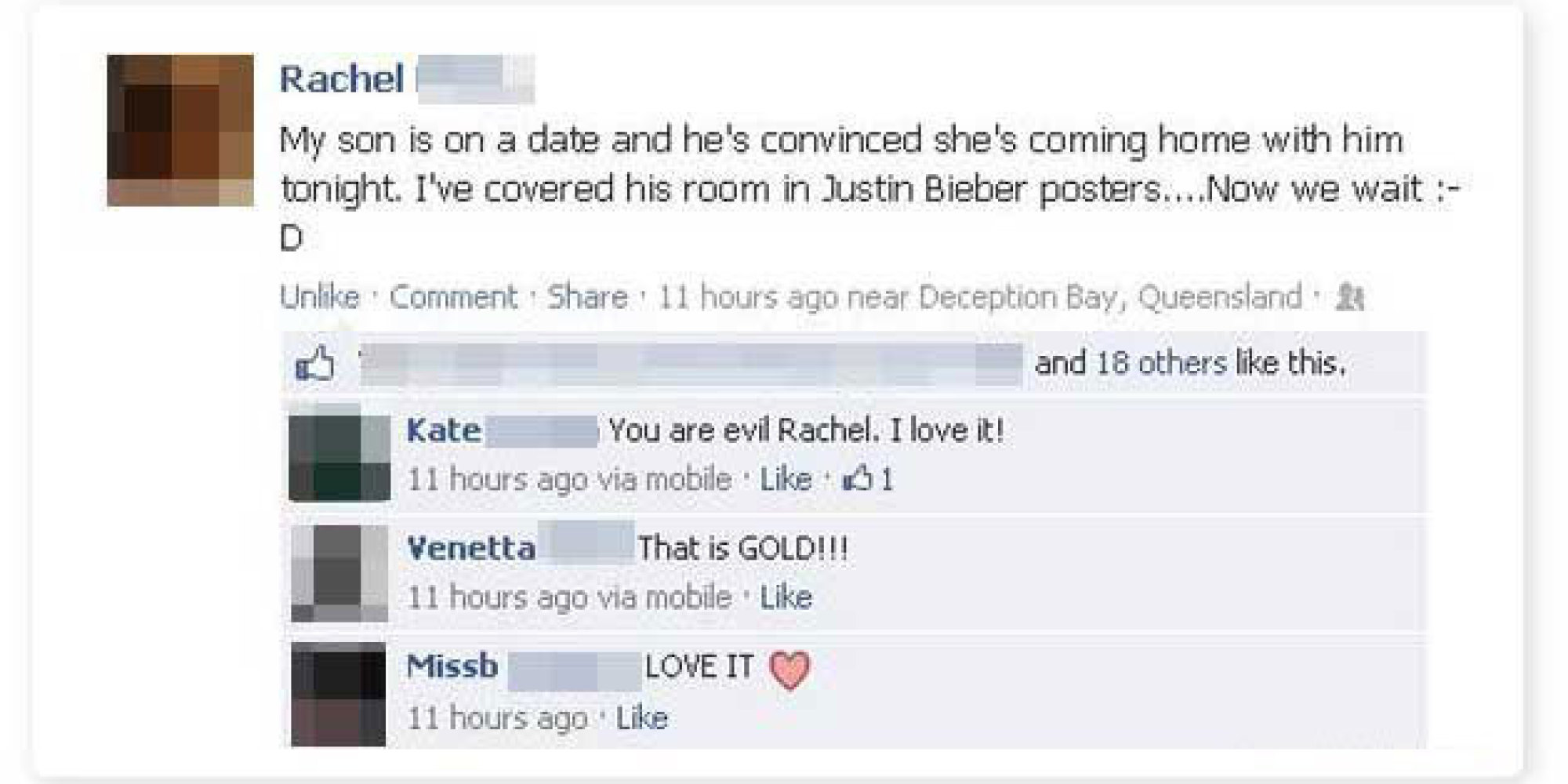 Credits: Huffington Post One of the top reasons why teenagers are leaving Facebook once and for all is because they felt awkward when their parents send them a friend's request. Do they accept the request and thus make their posts and updates visible to their parents? If they were to reject the request, would the parent feel upset? Dear parents, do give your children privacy; let them decide what to do or what friends to make on social media. On another note, some young parents today set up active Facebook accounts for their newborn babies. It seems fun and cute but it may not be good especially when the child turns into an adult. Give the children more space for the sake of their future well being, please! 8.) The Racist Jokers Racist buggers, be aware! Facebook or any other social media network is not a place to post uncalled for racist remarks. We have seen many people getting caught on social media for racist remarks; some have been fired by their employers; while some were scolded by hundreds of netizens around the world.  Credits: Howzyerteeth.Beacondeacon.com Respect other people's differences, race and culture. Sometimes out of fun and not disrespect, people may put racist jokes on Facebook. However, try to avoid that, because not everyone can accept these kind of jokes. 9.) I Like You – by a Stranger  Credits: EndlessOrigami.blogspot.com Stalkers! – in other words. Sometimes, without us realising it, just by looking at other people's Facebook profiles, we are acting like stalkers too! Many of us are curious and gossispy by nature, so we may like to follow our friends' updates. This is still acceptable (assuming that none of our Facebook friends are criminal stalkers). To play safe, only add friends that you know personally. Avoid accepting friend's requests from strangers or you will be freaking out someday! 10.) Begging for Likes  Credits: IRunTheInternet.com It is not funny, there are real people like that today! They will beg for Facebook likes. These people will call you in the middle of the night, to ask you to 'like' their latest photo on Facebook or like their Facebook page. They feel lousy when nobody like their photos. Well, if your best friend has this "Likes Begging Syndrome", take him or her out for a walk or something. Tell him or her that there is life better than Facebook in the real world. Okay! There you have, the top 10 freaky things that people do on Facebook. Like my blog for more awesome marketing updates!  |

 Last weekend I watched
  With this "truth" content, anyone who expresses disdain toward SeaWorld in relation to Blackfish is messaged, targeted or directed toward this page. It's almost like a content war, where both sides offer useful, but contradicting information. That's where transparency, trust and brand loyalty surface to play an influential role, as advocates and activists scramble to defend or attack the SeaWorld name.


 so your marketing efforts—including social media—need to change and mature as well. Stay informed about marketing trends and best practices by committing yourself and your company to continual learning. Let us dive into how you can leverage social media to advance your business this year.
 valuable, in-depth thought leadership. Content is your avenue for getting highly ranked by Google, gaining recognition as an industry thought leader, reaching a wider captive audience, and amplifying lead generation and new business. Publishing such content is a major hurdle to inbound marketing success. However, your
| You are subscribed to email updates from Popular Articles | Business 2 Community To stop receiving these emails, you may unsubscribe now. | Email delivery powered by Google |
| Google Inc., 20 West Kinzie, Chicago IL USA 60610 | |
